
The dream of “Rosie-the-Robot” is inching closer to reality with
Neo, the humanoid housekeeper created by 1X Technologies. This 5-foot-6-inch, 66-pound robot, which looks like a cross between a fencing instructor and a Lululemon mannequin, is designed to take on the dirty work of the unpredictable home environment. While the technology feels wild to watch, the sources reveal that Neo is still very much a work in progress, relying on human assistance to learn.
The Early Adopter Reality and the Price Tag
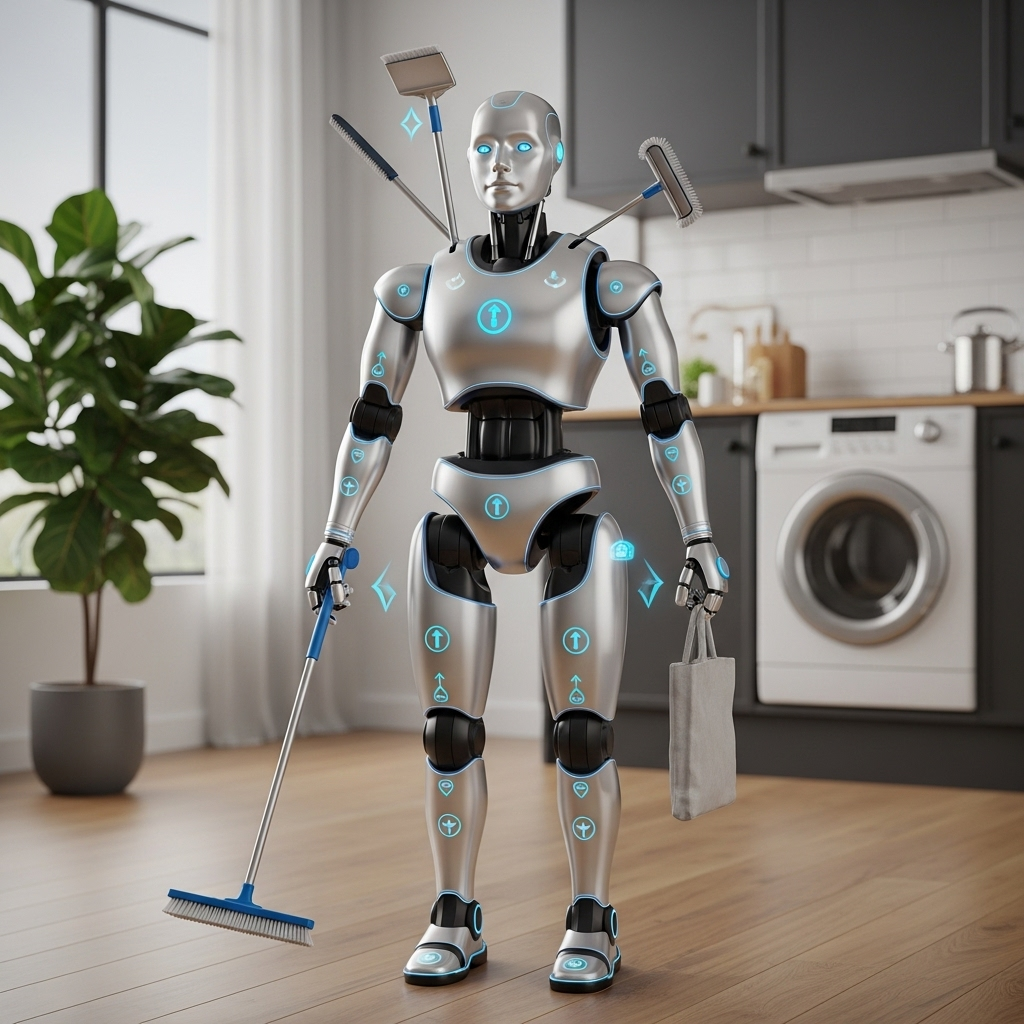
Neo is not yet ready to operate fully autonomously. During tests, it successfully completed tasks like retrieving a water bottle from the fridge, wiping a counter, and loading a dishwasher (a five-minute process), but often struggled—it nearly toppled closing the dishwasher, and took two minutes to fold a sweater. The company is addressing safety by designing Neo to be “provably safe,” using lightweight construction and motors that pull on synthetic tendons (instead of heavy gears), limiting its speed and force. Its finger strength is roughly equivalent to a human’s; for instance, it could not crack a walnut. Initially, it will not handle anything hot, heavy (it tops out at 55 pounds), or sharp.
For those ready to invite this physical AI into their lives, 1X is launching an early adopter program. You can preorder Neo for $20,000, with delivery expected in 2026, or opt for a $499 monthly rental plan with a six-month minimum commitment.
The Hidden Cost: Privacy and the “Social Contract”
The biggest current challenge is Neo’s reliance on human oversight, which comes at the cost of the user’s privacy. To perform tasks like loading the dishwasher or folding laundry, a 1X expert teleoperator must wear a VR headset and use video-game-like controllers to guide the robot’s actions. The robot’s smart brain—an AI neural network—learns by capturing videos of every chore done in the real world, which are then fed into its world model.
CEO Bernt Børnich acknowledges that users must be “OK with that social contract,” noting that without customer data, the company cannot improve the product. This means a company representative may potentially “peer through the robot’s camera eyes” to get chores done.
However, 1X emphasizes that the user remains “always in control”. Users can schedule sessions in an app, set no-go zones, blur faces in the video feed, and must approve an operator connection. Videos used for training data will not be accessible to employees without the user’s consent. Børnich compares this teleoperation to hiring a vetted and monitored house cleaner.
Raising a Robot
The ultimate goal is for Neo to perform all household tasks autonomously. Børnich predicts that by 2026, Neo will do “most of the things in your home autonomously,” although the quality may initially resemble “robotics slop”—meaning the results might not be perfect (e.g., messy cabinet glasses or an untucked shirt arm), but they will be useful and will “improve drastically” as the company gathers more data.
For the next few years, owning Neo won’t be about having a capable robot immediately, but about “raising one,” allowing it to learn the home, routines, and chores. This marks the dawn of physical AI moving through private spaces, a reality that the company expects to accelerate whether through 1X, Tesla, or other startups like Figure.
Hi, this is a comment.
To get started with moderating, editing, and deleting comments, please visit the Comments screen in the dashboard.
Commenter avatars come from Gravatar.